
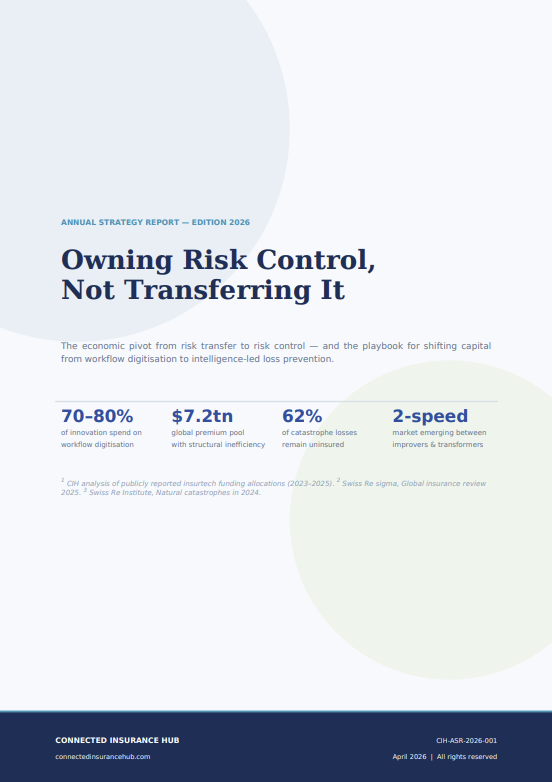
Annual strategy report · Edition 2026 · April 2026
Owning Risk Control, Not Transferring It. The economic pivot from risk transfer to risk control, and the playbook for shifting capital from workflow digitisation to intelligence-led loss prevention. Written for insurers, brokers, investors and the technology companies that sell to them.
The six findings
The strongest firms will not be the ones that digitise workflow fastest. They will be the ones that build trusted decisioning, actuarially credible prevention, and control over whether loss occurs at all.
The industry is optimising the wrong layer. Most innovation capital remains in workflow efficiency, while the largest economic value sits in decisioning and prevention.
The real moat is trusted decisioning. Proprietary data is commoditising; what differentiates leaders is regulatorily defensible, operationally embedded decisions.
Prevention is the largest untapped profit pool. Loss avoidance improves the combined ratio structurally, but most propositions fail to generate the proof underwriting needs.
Claims is undervalued as a control point. Claims sits closest to real-world loss patterns, leakage, fraud and severity.
Operating models are the hidden bottleneck. Transformation fails most often on P&L ownership, integration and budgets misaligned with where value is created.
A two-speed market is emerging. Incremental improvers will protect margin through efficiency; economic transformers will expand it through decisioning, prevention and direct risk control.
The central argument. Competitive advantage in insurance is not determined by who predicts risk best, but by who can actively change risk outcomes. As predictive capability becomes widespread, differentiation comes from influencing risk, not identifying it.
What is inside
- Five structural forces redefining insurance economics, from capital and regulation to the growing observability of loss drivers.
- Where value will be captured across underwriting margin, loss cost, claims expense, service economics and data advantage, today and in the future state.
- Priority segments in three tiers, from the fastest routes to proof (escape of water, fleet, cyber monitoring) to longer-horizon bets.
- Why prevention only scales when underwriting, finance and regulation can recognise it: counterfactual clarity, measurable impact and time to proof.
- Modelled P&L scenarios for a household property book, a commercial fleet book and a cyber book, with ranges and time to proof.
- Market sizing for UK escape-of-water prevention, commercial motor risk-control technology and active cyber insurance.
- A buyer map of who is actively buying risk-control technology, where the budget sits and how complex integration is.
- The commercial models that work in insurance-technology partnerships, with typical contract values and pilot-to-production rates.
- What UK, EU and US regulators now expect of models and data used in pricing and underwriting.
Contents
- Executive summary
- Market context: five structural forces
- Where value will be captured
- Priority segments
- Winners and losers
- Proof of prevention
- Quantified scenarios by line of business
- Market sizing
- Competitive intelligence
- Buyer map
- Deal structures
- Regulation
- Appendix: where causes of loss meet intervention
- Methodology
Get the report
Full report
£495 PDF
- Full report, 23 pages
- Modelled scenarios and market sizing
- Instant download after payment
Leadership briefing
On request for your team
- A session on the findings for your leadership team
- Applied to your lines of business and partners
- Scoped to your questions
Prices exclude VAT where applicable. Published April 2026. The Connected Insurance Hub accepts no vendor sponsorship; inclusion of a vendor does not imply endorsement.