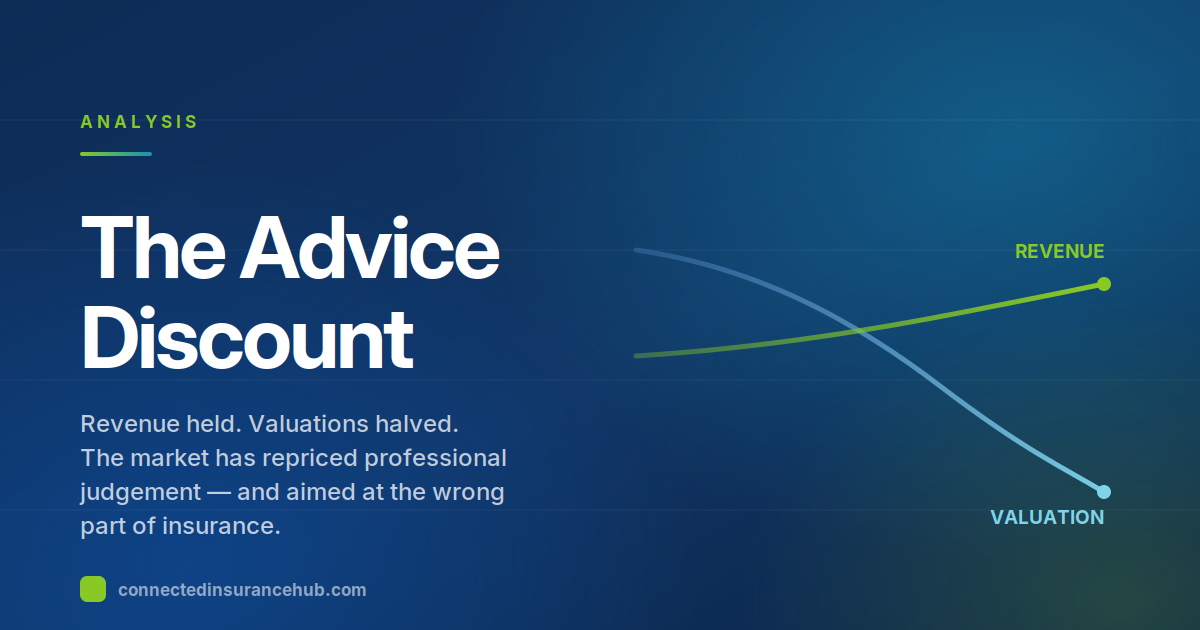
Equity markets have started to price artificial intelligence disruption directly into the valuations of firms that sell professional judgement. Insurance broking has had its first repricing. It was aimed at the wrong part of the business.
The rotation that actually happened
The familiar account of the last three years is that capital left conventional equities for artificial intelligence. That was the 2023 to 2025 trade, and it has since reversed: through the first half of 2026, industrial, energy and consumer defensive names led markets while technology faltered, as investors began demanding evidence that unprecedented capital expenditure would convert into durable returns.
That reversal is the visible half of the story and the less interesting one. Underneath it, artificial intelligence has stopped functioning as a broad valuation tailwind and started functioning as a source of scrutiny. Markets are no longer only buying the companies expected to benefit. They are selling the companies expected to be displaced.
For any business whose revenue derives from the sale of expert judgement, that distinction is the whole question.
Professional services has already been repriced
The clearest evidence sits outside insurance. Over the twelve months to mid-2026, Accenture lost more than half its market value. Capgemini shed close to forty per cent. The London-listed legal services group Gateley fell more than sixty per cent.
The operating results over the same period do not explain those moves. Accenture reported third-quarter revenue of $18.7bn, up roughly six per cent year on year. Revenue grew. Valuation halved.
That gap is the thesis in a single data point. Share prices move for many reasons at once, and no single explanation should be treated as complete. But a substantial part of this reset appears to reflect investor expectations about the future fee pool rather than the current one — specifically, that corporate clients will increasingly perform in-house the analysis, drafting and reporting work they previously bought. Morningstar's equity research has characterised investors as taking the disruption question seriously enough to avoid the sector outright, and Bloomberg Intelligence attributed the single worst trading day in Accenture's history, in June 2026, to artificial intelligence eroding demand for consulting and managed services.
The market has run the experiment. The conclusion it reached is that work which consists of producing documents is worth materially less than it was, regardless of how senior the person producing them is.
Insurance had its own day
On 9 February 2026, listed insurance broking stocks fell sharply. A composite index of six listed brokers compiled by the consultancy MarshBerry closed down 8.9 per cent on the day, against a broadly flat S&P 500. The move carried into European insurance equities the following session.
No broad macroeconomic trigger accompanied it. Two developments had landed in close succession: OpenAI approved an insurer-built home insurance application operating inside ChatGPT, capable of returning personalised quotes without a broker interaction; and the comparison platform Insurify launched a motor insurance comparison application on the same surface.
What distinguished these from the general run of insurance technology announcements was the distribution mechanics. Through an application directory embedded in a conversational interface, third parties can place real products and real workflows inside the conversation itself. Conversational artificial intelligence moved from an information layer to an action layer.
Distribution economics are shaped by whoever controls the customer's starting point. If the first interaction occurs inside an artificial intelligence interface, the pathways built around websites, forms and comparison journeys become less central, and value migrates towards whoever controls or is discoverable within that new front door. The market appears to have reached that conclusion in a single session.
Key insight
The February repricing was a verdict on distribution, not on advice. It priced the risk that artificial intelligence captures the first click. It said nothing about the risk that artificial intelligence captures the work performed after the client has already chosen their adviser.
The consensus reassurance, and what it omits
The industry response to February was measured and largely correct as far as it went. Pressure is most acute in standardised, price-led journeys, particularly personal lines, where comparison is already established customer behaviour. Commercial and specialty lines look different, because value there is created through risk structuring, market access, negotiation and claims support — none of which reduces to a side-by-side comparison.
That argument defends placement. It does not defend the services layer that has accumulated around placement over the past two decades, and which now constitutes a substantial part of what commercial brokers and risk consultancies actually deliver:
- Policy wording review and coverage gap analysis
- Risk register construction and maintenance
- Process and procedure audits against recognised standards
- Training design and delivery
- Peer benchmarking and market commentary
- Claims preparation narratives and quantum documentation
- Board reporting packs and renewal presentations
Every item on that list is document production with a relationship attached. Most of it is bundled into commission or fee rather than itemised, which is precisely why it has escaped scrutiny — it does not appear as a discrete revenue line that an analyst can model, so nobody has repriced it.
Unbundled and examined, a significant portion of it is now reproducible by a competent risk manager with a subscription and an afternoon. The output will be less polished and occasionally wrong. It will also be free, immediate, and produced without a procurement cycle.
The obvious objection is that most insureds do not employ a capable risk function. That is true and largely beside the point. Pricing is set at the margin, not at the average. The question is not whether every client can perform this work; it is whether enough clients can perform enough of it to establish a reference price that the rest then negotiate against.
A durability test
Rather than sorting activities into safe and exposed, it is more useful to apply four questions to any piece of advisory work. Each question identifies something a language model structurally cannot supply.
1. Does someone bear liability for being wrong?
Regulated advice carries a duty of care and a professional indemnity policy behind it. A model produces an output; it does not accept a consequence. This does not mean the work must be performed without automation — a firm can generate, supervise and still be answerable for what it signs. The point is that the client is paying for the supervising entity: one with capital, cover and regulatory standing. Where the purchase is transferred responsibility rather than transferred effort, the work is durable.
2. Does it require access that cannot be synthesised?
Underwriting capacity, binding authority, a relationship with a specific market, the ability to convene a panel. Access is a permission, not an inference. No amount of capability generates it.
3. Does it require presence in the physical world?
Survey, inspection, verification, evidence collection. Remote sensing, aerial imagery and connected monitoring are closing the observation gap quickly, so the durable element is not the site visit itself. It is that someone must define the inspection standard, validate what the instruments returned, and accept responsibility for the conclusion drawn from it.
4. Does it depend on proprietary data rather than the public corpus?
Portfolio loss experience, claims development patterns, real benchmark data from comparable risks. Anything derived from publicly available text is now a commodity by definition.
Work that fails all four questions is a text-production business. Generic training courses, summarised policy comparisons, boilerplate risk registers, market commentary assembled from public sources and benchmarking built on published data all fail all four.
This is not an argument that documents lose their value. A well-drafted wording review embedded in a regulated relationship remains worth paying for. The distinction is narrower and more uncomfortable: documents cease to justify premium pricing once they can be generated independently of the adviser who delivers them. The question is not whether text is produced. It is whether text is the product.
What is genuinely protected
Two positions are structurally safe rather than merely defensible.
The first is capital and licensing. A model cannot hold a balance sheet, cannot be granted regulatory permission, and cannot pay a claim. The risk transfer function itself — the promise to indemnify, backed by capital and supervised by a regulator — is unaffected by any development in language modelling. This is the reason the indemnity side of the industry has been comparatively untroubled by the debate while the advisory side has not.
The second is adversarial negotiation. Where a counterparty has a financial incentive to disagree, capability on one side does not produce agreement. A disputed business interruption quantum is not resolved by generating a better-argued submission; it is resolved by two parties with money at stake reaching a position both will sign. Introducing artificial intelligence on both sides changes who does the drafting. It does not change who bears the exposure or who has authority to settle.
Claims preparation is instructive here because it splits cleanly down the middle. Assembling and formatting the documentation is exposed. Arguing the claim against an adjuster who is paid to resist it is not.
Two reasons this is not a contraction story
The first is that artificial intelligence commoditises diagnosis and, in doing so, increases demand for verification. Risk consultancy has always been rationed by cost, which is why it concentrates in the upper mid-market and above. Organisations that could never justify a formal risk assessment can now obtain a serviceable one. What they cannot obtain is confidence in it. More draft risk registers, more draft continuity plans and more draft coverage analyses produce more demand for review, correction and sign-off — which is to say, demand migrates from the first question in the durability test towards the fourth and back to the first. The fee pool does not simply compress. It redistributes towards whoever can validate an output rather than merely produce one.
The second is that the technology generates its own advisory demand. EPIC's sixteenth annual lawyers' professional liability survey, published in May 2026, found that seven of thirteen surveyed carriers reported an increase in artificial intelligence-related claims over the preceding year — the first credible loss emergence data specific to artificial intelligence in any professional liability line. Eight of thirteen reported higher overall claim frequency, the first such rise in five years.
Model governance, output validation, allocation of responsibility when an automated recommendation proves wrong, and the insurance of all of the above constitute advisory work that did not exist three years ago. The firms best placed to capture it are those with existing professional liability expertise and a credible view on how these systems fail.
Five positions worth taking
The instinctive response to a capability threat is to acquire the capability. This is almost always the wrong move, because any capability available for purchase is available to the client as well, usually at a lower price and with a shorter implementation. Firms that respond by buying tools are competing on the one axis where they have no advantage.
The productive response is to occupy the positions the capability cannot occupy. Each of the following maps directly onto one of the four durability questions.
1. Sell the warrant, not the draft.
Clients arriving with a machine-drafted risk register, policy summary or business continuity plan have a document and no confidence in it. The service they now need is review, correction and sign-off — a named professional stating that the document is fit for the purpose it will be used for, with professional indemnity cover standing behind that statement. This is straightforward to describe and difficult to execute, because it requires a firm to extend its liability to work it did not originate. Most will decline. That reluctance is precisely what makes the position defensible: the barrier to entry is appetite for risk, not access to technology. Firms that build a defensible review methodology — documented scope, defined limitations, clear exclusions — can price it as a discrete deliverable rather than absorbing it into commission.
2. Own the interpretation layer on sensor data.
Telematics providers, connected asset platforms and environmental monitoring vendors generate signal in volume. Almost none of them convert that signal into evidence an underwriter will accept, because doing so requires knowing what an underwriter needs to see and how they will discount it. The gap between a vendor dashboard and a defensible submission is where broking expertise is genuinely scarce. The commercially significant version of this is not reporting what the sensors observed; it is establishing what the intervention avoided — constructing the counterfactual, defending the comparison group, and translating the result into a case for rate. That capability is rare, it compounds with repetition, and it cannot be acquired off the shelf.
3. Instrument every deployment so it becomes a data asset.
Public information is now a commodity. Matched loss experience is not, and it is the only input to advisory work that improves with time and cannot be reproduced from a public corpus. Every pilot, every technology deployment and every risk improvement programme should be structured at the outset to produce a usable observation: baseline captured, control group identified, exposure normalised, outcome tracked past the point at which the client loses interest. Firms that treat pilots as sales events rather than experiments spend money and learn nothing, and arrive at the next conversation with anecdote where a competitor has evidence.
4. Own the inspection standard, not the equipment.
Physical verification is one of the strongest positions available, and drone-based survey is the most commonly proposed way of strengthening it. It is also the weakest version of the idea. Aerial survey is a purchasable service with falling unit costs, and the vendor selling it to a broker will sell it to that broker's clients within the same sales cycle. The durable asset is not the aircraft. It is the survey regime built around it: what gets inspected, at what cadence, against which standard, with what chain of custody, and whose signature appears on the finding. Equipment is a cost line. A recognised inspection standard that an underwriter will price against is a franchise. Firms doubling down on physical presence should invest in the methodology and the qualification of the people applying it, and treat the hardware as interchangeable.
5. Reprice before the client does it for you.
Advisory work bundled into commission is invisible until a client calculates what they are paying for it, and a client who can generate a comparable document in an afternoon will eventually run that calculation. Firms are better served unbundling on their own terms — separating the components that fail the durability test from those that pass, pricing the durable components explicitly, and moving where possible towards structures tied to outcomes rather than hours or documents. Retainers for access, fees contingent on measured loss reduction, and charges for assurance and sign-off all survive the transition. Fees justified by effort do not.
Key insight
Automation releases capacity. Capacity that is not deliberately redeployed into durable work does not become margin — it becomes a lower price. The efficiency gain is only a strategic gain if the time it frees is reinvested in the positions a model cannot occupy.
Two responses are worth avoiding. The first is building an internal assistant that replicates a commodity capability, which consumes budget and change capacity to reach parity with a subscription. The second is repositioning as technology-enabled without altering what is actually sold; a client who receives the same deliverables, produced faster, will reasonably expect to pay less for them.
The firms that emerge from this period in a stronger position will not be those that adopted the technology earliest. They will be those that identified which parts of their revenue depended on producing text, and moved that capacity into evidence, verification and accountability before the market required them to.
The line that matters
The question posed by the February sell-off is usually framed as whether artificial intelligence will replace advisers. That framing produces unhelpful answers, because the honest response is that it will replace some of what advisers do and none of what advisers are for.
The more precise question is what the client is actually paying for. Where the answer is analysis, the price is falling and will continue to fall. Where the answer is access, verification, accountability or the ability to make a claim on someone else's balance sheet, the price is unaffected.
A model can generate a risk report of reasonable quality in under a minute. What it cannot do is generate a loss history, inspect the premises, warrant its own conclusion, or answer for that conclusion when it turns out to be wrong.
Which is the same conclusion the insurance market has been arriving at from the opposite direction for several years. Underwriters do not pay for claims about risk. They pay for evidence, and they pay for someone prepared to stand behind it. The advisory business is converging on precisely the same standard, and for precisely the same reason. What survives is not the analysis. It is the evidence underneath it and the accountability attached to it.
Sources
MarshBerry, "Is AI Rewriting the Rules of Insurance Distribution and Valuation?" (11 February 2026)
Financial News, "Consulting Firms Face AI Threat as Shares Slide Up to 57%" (25 June 2026)
Morgan Stanley, "Market Rotation Out of Big Tech: AI Capex and Key Drivers" (2026)
Morningstar, "6 Stocks Driving the 2026 Stock Market Rotation" (February 2026)
Penn Mutual Asset Management, "When AI Became a Headwind: Dispersion and Rotation in Early 2026" (26 February 2026)
EPIC Insurance Brokers, 16th Annual Lawyers' Professional Liability Claims Survey (May 2026)
Forrester, "The Future of AI Consulting Services Is Disruptively Bright" (2026)
This article discusses publicly reported market movements as a signal of investor expectation. It is analysis of industry structure and does not constitute investment advice or a view on any individual security.
Where does your proposition sit on the durability test?
The Partnership Readiness Diagnostic assesses whether a risk technology proposition rests on evidence an insurance market will accept — or on analysis it can now generate itself.
Take the free diagnostic