
Escape of water is the clearest test the market has of whether prevention technology can be underwritten. The loss is frequent, expensive and largely mechanical. The devices are cheap, and the claims data needed to measure them already sits in insurers' systems.
The cost is rising. In written evidence to the Treasury Committee in April 2026, the ABI reported that escape-of-water claims on multi-occupancy buildings rose from £652 million in 2017 to £1.3 billion in 2025. Insurers are paying around £1.8 million a day on these claims (ABI correspondence, April 2026).
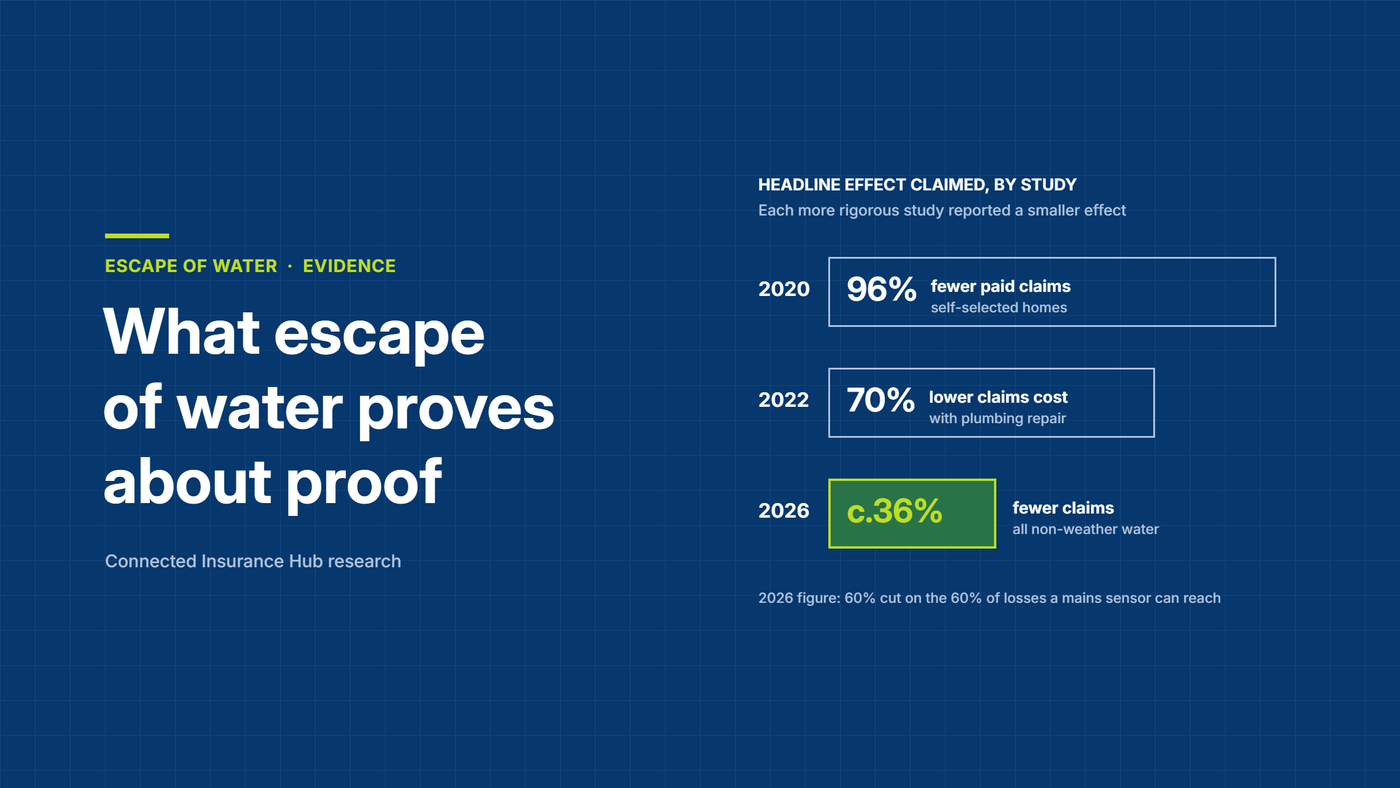
The evidence that leak detection reduces this loss has followed a pattern the industry should study. Each successive headline figure has been smaller than the last, and each has been more credible.
The number that kept shrinking
| Year | Study | Headline claim | Scope of the claim |
|---|---|---|---|
| 2020 | Data analytics firm with a shut-off valve manufacturer, 2,306 US homes (source) | 96% fewer paid water claims | All water leak claims, two years, self-selected installers |
| 2022 | Vendor-commissioned research across the UK, US and Denmark (source) | Up to 70% lower claims cost | Best market (UK) with integrated plumbing repair; 44% on average across the three markets |
| 2026 | Vendor authors, co-authored with the IoT Insurance Observatory, four US carriers (source) | 60% lower frequency | Pressurised-side losses only, mature programmes only |
The 2026 paper states that 60% of non-weather water losses arise on the pressurised side of the system. A 60% cut to 60% of losses is a reduction of roughly 36% in non-weather water claim frequency, before any effect on severity. That is still a large effect, and it is around a third of the figure first put in front of underwriters.
Why the first numbers were too big
The early figures were inflated by study design. The devices may well work; the studies were simply not built to show how much.
The 2020 study compared homes whose owners had bought and installed a shut-off valve with a control group of 1.3 million homes matched on geography, price and size (source). Households that pay for a water shut-off are unlikely to be typical. They are more likely to maintain their plumbing, notice a stain and call a plumber early. Matching on property characteristics does not remove that difference. Adoption was also unusual: the same research put leak sensor installation at only 6% to 7% of homes (source).
The baseline also moved. Over the same two years the control group's claims rose by 10%, so part of the gap reflects a deteriorating comparison group rather than an improving treated one.
The 2022 figure combined detection with an integrated repair service, and its strongest result came from the market where that service was most complete. That is a legitimate finding about a bundled intervention. It is not evidence about a sensor on its own.
The 2026 paper deserves credit for naming these problems itself. It identifies underpowered samples, uncorrected selection bias and hidden programme costs as the reasons most loss-prevention studies fail actuarial review, and it notes that benefits only appear once a programme matures (source). Its authors remain the vendor's own staff, and the full report sits behind a registration form. Under the evidence standard used on this site, it is vendor-produced evidence of unusually good quality, and it still cannot carry the argument on its own.
Scoring the evidence against the Five Gates
Domestic leak detection clears two of the Five Gates, is partway through two more and has not yet reached Exportability. On the proof ladder, that places it above Correlation and short of Credible causal evidence.
| Gate | What the evidence shows | Status |
|---|---|---|
| Attribution | Matched comparisons and mature cohorts, but no randomised allocation of devices among existing policyholders. Self-selection is acknowledged and only partly addressed. | Amber |
| Honest Baseline | Early studies compared against a control group whose claims were rising. The 2026 paper restricts the claim to the pressurised side, which is the loss the device can physically affect. | Amber |
| Persistence | Results are reported for mature programmes across tens of thousands of underwriting years. Whether alerts keep being acted on after the novelty fades is not separately reported. | Green |
| Exportability | The strongest data comes from US single-family homes. UK flats, mixed-tenure blocks and construction sites have different plumbing, ownership and response times. | Red |
| Materiality | Even the reduced figure of roughly 36% of non-weather water frequency is large enough to move a household loss ratio. | Green |
Attribution is still the gate that matters most. A randomised offer of devices to a random half of renewing customers, with claims followed for three years, would settle the question for one insurer's book. None of the studies reviewed here did this. The obstacle is commercial rather than technical: it means deliberately withholding a protective device from half of a portfolio.
Three routes from evidence to market
Leak detection is reaching the market through conditions of cover and calls for mandates, while the rating-factor route has barely moved. That is the correct order given the evidence, and technology companies should plan for it.
| Route | Evidence it needs | Who pays for the device | Where it stands in the UK |
|---|---|---|---|
| Rating factor or discount | Credible causal evidence on the insurer's own book, then a filed factor | Insurer, through lower premium | Uncommon; the household programmes reviewed here give the device away and keep the claims saving |
| Condition of cover | Expert consensus that the control is good practice | The insured, as a cost of getting cover | Construction: the Joint Code of Practice applies to projects over £2.5 million and is expected to become a condition of insurance (source) |
| Mandate | Policy consensus that the loss is a public cost | Building owners, through regulation | The ABI's ten proposed measures to the Treasury Committee begin with mandatory leak detection (source) |
The prevention-to-pricing gap explains why the first route is slowest. A discount commits the insurer to an effect size it must defend to its actuaries and, eventually, to its reinsurers. A condition of cover asks only that the control is reasonable. A mandate asks only that it is cheap relative to the loss.
Construction shows the condition route working. The code was produced by RISCAuthority and the Construction Insurance Risk Engineers Group, published by the Fire Protection Association and endorsed by the plumbing profession (source). It requires a water systems management plan and wet work permits. Some insurers now require automatic shut-off systems on high-rise residential projects, and water damage deductibles have risen sharply (source). None of that waited for a randomised trial.
The commercial implication for technology companies is direct. A vendor that waits for a premium discount will wait years. A vendor that helps insureds meet a condition of cover, and produces auditable records that the condition was met, has a buyer this year.
What the evidence cannot yet establish
The published studies leave four questions open, and each matters most in the UK.
- Multi-occupancy severity. The fastest-growing UK loss is in blocks of flats, where one leak reaches several units. The studies measure single dwellings, mostly in the US.
- Drain-side losses. By the 2026 paper's own split, 40% of non-weather water losses arise on the drain side, which a mains sensor does not monitor (source).
- Detection without repair. The strongest UK result came with an integrated plumbing service. How much of the effect survives where the policyholder must find and pay their own plumber is unknown.
- Cost under a mass offer. The reported returns range from 40% in mass-market homes to 980% in high-net-worth homes. Most UK household books sit at the low end of that range, where the margin for error is thinnest.
The position taken here would be wrong under specific conditions. If a randomised offer on a UK book showed a frequency reduction below 15% after three years, the effect would be too small to price. If programmes lost more than half of their engaged users within two years, Persistence would fail. If the best results only appeared in self-installing households, the effect would be selection, and the device would be a retention tool, and should be bought as one.
Five questions to put to a leak-detection vendor
An underwriter assessing a water programme can test it with five questions, in this order.
- Which part of the water system does the device monitor, and what share of your own escape-of-water losses arise there?
- How were devices allocated in the study, and what was done about households that chose to install?
- What happened to the comparison group's claims over the same period?
- How much of the effect depends on a repair service, and who pays for that service at scale?
- Where has the result been reproduced on a book like ours, in property type, tenure and market?
These map directly onto the gates. A vendor that answers all five clearly is ready for a pilot designed to settle Attribution on the insurer's own data. The Evidence Credibility Calculator scores a claim against them, and the evidence and pilot design review turns the answers into a trial an actuary will accept.
The verdict
Escape of water is the best-evidenced prevention case in property, and the shrinking number is a sign of progress. A 36% frequency reduction that survives scrutiny is worth more to an underwriter than a 96% figure that cannot. For now it supports conditions of cover and mandates better than discounts, and that is where the market is already moving. The next step on the proof ladder is a randomised offer on a UK book. Whoever runs it first will set the price for everyone else.
Sources
- ABI correspondence to the Treasury Committee, April 2026 (summary)
- Digital Insurance: 2020 leak detector claims study
- PropertyCasualty360: 2020 study control group
- Insurance Edge: 2022 Counting the Savings study
- Insurance Thought Leadership: 2026 results summary
- Insurance Thought Leadership: 2026 paper, study problems
- CIPHE: Joint Code of Practice for escape of water published
- Griffiths & Armour: scope of the Joint Code of Practice
- Lockton: escape of water on building sites