
Insurers are offered more prevention technology every year: braking systems, telematics, wearables, leak sensors, computer vision, wellbeing platforms. Most arrive with a headline figure. Few arrive with evidence that would survive an underwriter's questions.
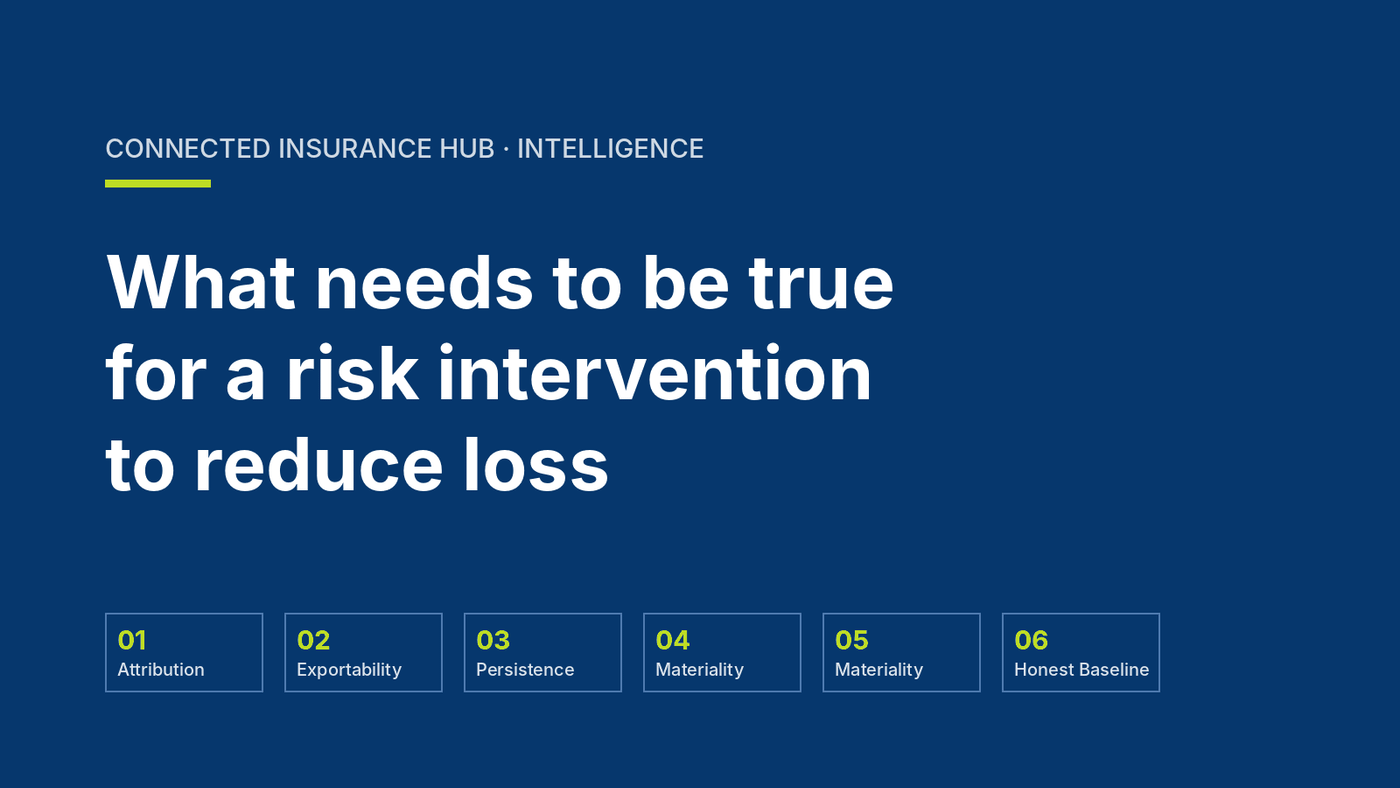
Connected Insurance Hub has graded 125 published findings on what risk technology and prevention do to crashes, injuries and insured losses. Each finding is tiered by who produced it, placed on the proof ladder and read against the Five Gates. Read together, the findings that show a real reduction in loss share six conditions. The interventions that fail, or that look better than they are, usually miss at least one.
1. It works without people having to choose to comply
The clearest effects in the register come from controls that act automatically or are engineered into the task. Front automatic emergency braking reduced bodily injury liability claim frequency by 23.6% across insurer data (0046). Motorcycle anti-lock braking reduced collision claim frequency by 21% after controlling for riders' claim history (0090). Slip-resistant shoes issued free to food service workers cut slip injury compensation claims by 67% in a randomised trial (0066). Mechanical lifts with a no-manual-lift policy point the same way: handling injury claims in nursing homes fell by around 61%, although that study compared before and after without a control group (0068).
Interventions that depend on remembered behaviour perform poorly. A Cochrane review found no evidence that manual handling training prevents back pain (0067). A randomised trial of 19,500 employees found no reduction in phishing failure from annual or embedded training (0102). Post-licence driver education shows no effect on crashes (0054).
Gate: Attribution.
2. It targets a defined mechanism in the people or assets at risk
Slip-resistant footwear works in food service because it addresses the dominant hazard in that workplace (0066). Sleep apnoea in truck drivers shows the same logic: drivers who did not follow treatment had about five times the preventable crash rate of matched controls, while drivers who followed treatment did not differ from controls (0085). Drivers chose whether to follow treatment, so that comparison is self-selected, and it supports targeted screening as a strong signal more than as proof of effect.
Broad programmes offered to everyone tend to change habits without changing cost. Two large randomised trials of workplace wellness found no significant effect on medical spending or absence (0073, 0074).
Gate: Exportability.
3. It stays in place
Effects last as long as the control does. Alcohol interlocks reduce reoffending while fitted and show no benefit after removal (0093). Cash incentives raised activity in a Singapore trial, then activity fell back to baseline once payments stopped (0077). Features fitted for the life of a vehicle hold their effect.
Gate: Persistence.
4. It moves the outcome that is paid for
A change in a behaviour score is an early step on the way to lower loss, and the evidence has to reach claims. Handheld phone bans reduced phone use without changing collision claim rates (0094). Wellness trials improved self-reported exercise without moving spending (0074). Several promising coaching and incentive programmes report behaviour change only (0083).
Gate: Materiality.
5. It works where the losses are concentrated
Pedestrian automatic emergency braking lowered pedestrian crashes by 27% overall, with no measurable effect at night on unlit roads. About 75% of fatal pedestrian crashes happen in the dark (0088). Reversing systems remove large numbers of low-cost claims, so average claim cost can rise even as frequency falls (0089). An effect is only as valuable as the share of loss it reaches.
Gate: Materiality.
6. The comparison is fair
Comparisons between people who join a programme and people who do not overstate its effect, because healthier or safer people are more likely to join. The Illinois trial showed this directly: participants were already healthier and spent less before the programme began (0073). Engagement-tier comparisons in incentive programmes show large differences in mortality and claims (0081, 0082). Those differences are real and useful for segmentation. They are weak evidence that the programme caused them. Studies that measure claims only after a device is installed following a loss carry the same problem (0003).
Gate: Honest Baseline.
What this means for underwriters and risk managers
The register assigns each finding a use class.
- Rating credit candidate. Causal, claims- or crash-level, lasting and transferable. Examples: front and rear automatic emergency braking, motorcycle ABS, sprinklers and slip-resistant footwear in food service. Verify that the feature is fitted and in use, then consider a credit.
- Pilot or bursary. Plausible mechanism and positive early results, without independent proof in the setting at hand. Examples: leak detection with shut-off, posture wearables, computer vision on CCTV, fatigue monitoring. The route to a credit is a co-funded pilot with a comparison group and a defined claims outcome.
- Underwriting signal. Evidence that the risk is understood and managed, such as speed limiting, sleep apnoea screening, patching cadence or outside-in security ratings. These support appetite, terms and risk-quality scoring. A fixed discount needs stronger evidence.
- Do not credit. Credible evidence of no effect on loss: training-only programmes, general wellness, post-licence education.
For a risk manager, the same view sets priorities. Spend first on controls that meet the six conditions. Where an intervention sits in the pilot class, design the pilot so that it produces evidence an underwriter can use. Where it sits in the do-not-credit class, do not expect it to move premium.
How to use the evidence
The headline reading is open to everyone at What works. The full Evidence Register, open to members, holds every record with its source, design, caveats and verdict, and includes an avoided loss estimator that applies published effects to a client's own claims figures. Its estimates describe avoided loss under stated assumptions. They do not guarantee premium savings.
Evidence and pilot design review, £2,950
An independent read of the evidence behind a technology proposition, and a pilot design that produces evidence an underwriter can use.