
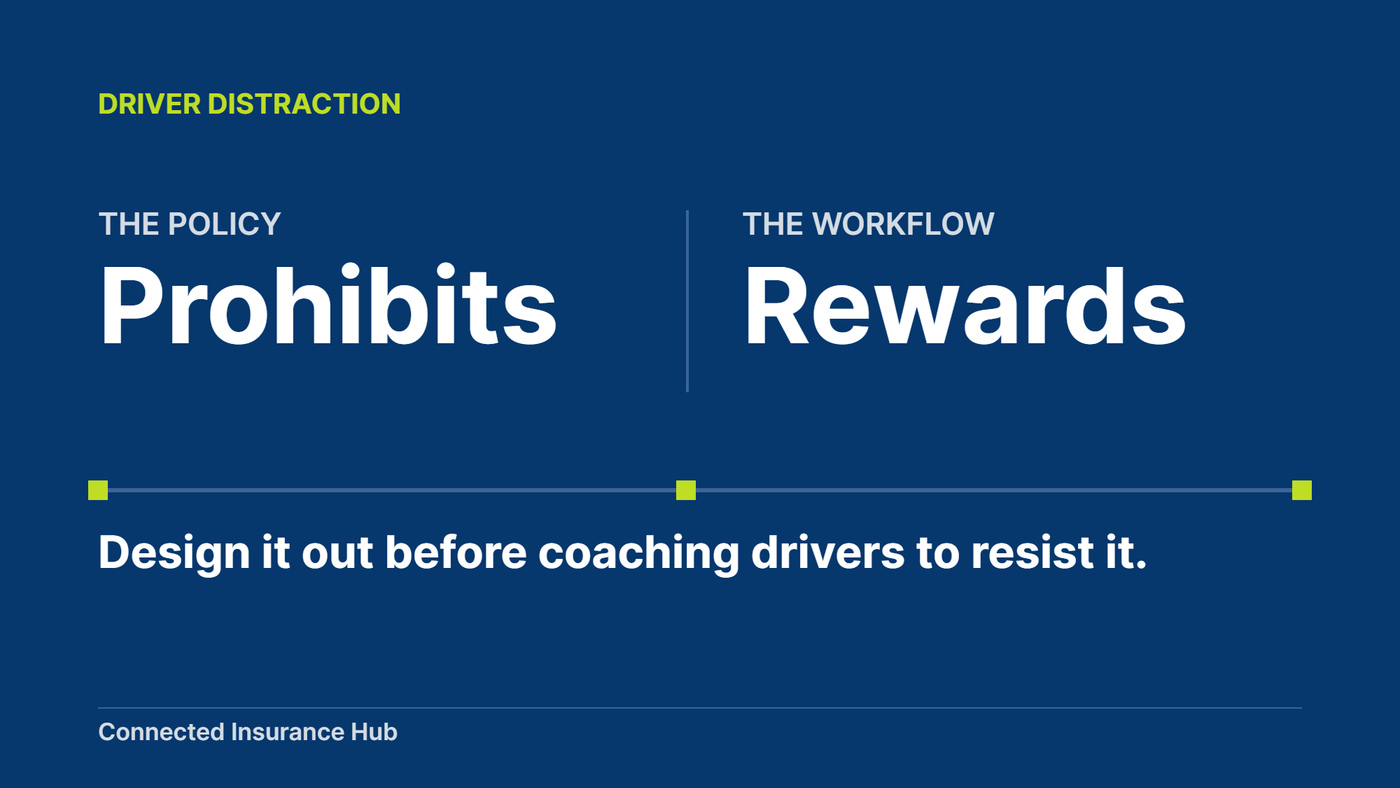
Most fleets have a policy that bans handheld phone use at the wheel. Many of the same fleets send jobs to a cab-mounted screen while the vehicle is moving, allocate work to whoever replies first, and judge controllers on how fast drivers respond. When the written rule and the working day point in opposite directions, the working day usually wins.
The research on commercial driver distraction supports a blunt conclusion. A large share of the distraction risk that fleets can control is created by the operation itself, and it should be designed out before drivers are coached to resist it.
The strongest finding is about work equipment
The most widely cited naturalistic study of commercial truck drivers recorded drivers on camera across a large volume of real-world driving and compared what they were doing in the moments before safety-critical events with ordinary driving [1].
Texting draws the headlines, but the dispatch device is the more important result for fleet operators. It is equipment the employer chose, installed and connected to the workflow, and the interval around the estimate is narrow. Experimental meta-analyses point the same way: tasks that take the eyes and hands away from driving carry clear performance costs, and moving to hands-free removes the manual demand while leaving the cognitive load in place [2,3].
Safety-critical events combine crashes, near-crashes and lane deviations. An odds ratio for events is a measure of association in a study population. It is not a multiplier for claims frequency or cost, and no intervention trial has yet tested what removing dispatch interaction does to insured losses.
Where the pressure comes from
Safety climate research explains why drivers keep interacting despite the rules. Among truck drivers, perceptions of how the organisation handles communications, management commitment and work pressure were related to self-reported distracted driving [4]. An earlier study of people who drive for work found climate predicted their driving behaviour, with the clearest effect on distraction [5]. UK research on gig-economy drivers documented direct pressure to use phones and to speed in order to keep work flowing [6].
This evidence is largely self-reported and cross-sectional, so it cannot settle causal direction. It is consistent enough to frame the first diagnostic question for any operation: does the business reward immediate responsiveness while its policy prohibits it?
A violation shaped by the work
Reason's classic taxonomy of driver behaviour separates unintended lapses and errors from deliberate violations [7]. The distinction matters because each calls for a different response.
| Behaviour type | Work-driving example | Primary lever |
|---|---|---|
| Lapse | Missing a braking vehicle after a night of short sleep | Scheduling, recovery and workload design, with in-cab alerting |
| Error | Misjudging a gap while searching for a delivery address | Route planning and navigation design, supported by training |
| Routine violation | Replying to dispatch while driving because jobs go to the first responder | Change what rewards it first; then the norm; then enforcement |
| Situational violation | Speeding to meet a slot booked without realistic drive time | Achievable scheduling and a penalty-free way to flag unachievable jobs |
In-motion device use at work often looks like a routine violation: repeated, widely shared and quietly tolerated because it keeps the operation moving. Treating it as individual misconduct leaves the cause in place. Incident investigation should establish which type of behaviour occurred before the response is chosen.
Diagnosing it with COM-B
The COM-B model holds that a behaviour occurs when capability, opportunity and motivation are all present [8]. Applied to device use at the wheel, it turns a compliance problem into a set of questions that can be investigated.
| Component | Question for the operation |
|---|---|
| Capability | Do drivers understand the risk, the law and the policy, and can they operate in-cab equipment safely? |
| Physical opportunity | Does any workflow require a screen response while moving? Are there safe places to stop? |
| Social opportunity | Do controllers or customers expect immediate replies? Is responding the norm among drivers? |
| Reflective motivation | Do pay, job allocation or performance measures reward responsiveness? |
| Automatic motivation | Is checking triggered by notification sounds and reinforced by habit? |
Most distraction programmes concentrate on capability, through policy briefings and training. In operations where the screen demands a reply and the job goes to the fastest responder, the barrier sits in opportunity and motivation, and training will not move it.
Why self-regulation is a weak control
Relying on drivers to judge their own risk runs into predictable biases. Most drivers rate themselves as safer and more skilled than average [9], so generic risk messages are easily discounted. Legal hands-free use can feel safe although the cognitive interference remains [2]. Drivers do tend to time secondary tasks to quieter moments, which reduces some risk, but it cannot be relied on when a job allocation depends on a fast answer.
What to change first
The sequence below is a prevention judgement. It rests on the mechanism evidence above and has not been tested against coaching alone in a controlled trial.
- Remove the demand. Queue work messages while the vehicle is moving and switch driving modes on by default. Load routes and job details before departure.
- Change what is rewarded. Stop allocating jobs to the first responder. Measure controllers on safe re-planning rather than response time.
- Set the norm. Controllers and supervisors do not call drivers they know are driving, and customers are told when a reply will come.
- Give drivers a way out. Provide safe stopping points and a route to decline an unachievable slot without losing pay or work.
- Then coach and enforce. Video monitoring with coaching has the best direct evidence among behavioural interventions: at two US carriers, safety-critical events per 10,000 miles fell by 38% and 52%, although reductions in severe events were not significant and the study had no control group [10]. Coaching works best once the workflow no longer pushes drivers the other way.
Measuring whether it worked
Collision counts move too slowly to show whether a workflow change has taken hold. Leading indicators can show it within weeks.
- Work messages sent to moving vehicles. This should fall as queuing and allocation changes take effect.
- Jobs re-planned after disruption. Low values may mean pressure is being passed to drivers.
- Near-miss and unfit-to-drive reports. A rise can indicate greater trust in the reporting route.
- Event recurrence after coaching. Completion of coaching sessions measures activity. Recurrence measures effect.
Driver-facing cameras and phone-use data are worker monitoring under UK GDPR. The ICO treats consent as usually inappropriate in employment, so employers need another lawful basis, a data protection impact assessment where monitoring is likely to be high-risk, and clear information for drivers [11]. Programmes that drivers see as purely punitive also tend to produce disputed events and under-reporting.
What it means for insurers and technology partners
For insurers and brokers, management practices such as message queuing, job allocation rules and paid waiting time are relevant indicators for risk selection and improvement. Their predictive value has not been validated against claims experience, and they should be treated as hypotheses to test in the book.
For technology companies selling monitoring or coaching, the evidence is a commercial argument as much as a safety one. A deployment that detects distraction in an operation still designed to create it will report the same events month after month. Propositions that pair detection with workflow redesign have the stronger case to put to an underwriter, provided the pilot is designed to show the difference.
The Behavioural Design audit scores a risk-technology proposition against the COM-B model and shows where behaviour change is likely to stall. It is free and takes about six minutes.
Run the Behavioural Design audit Discuss your opportunity- Olson RL, Hanowski RJ, Hickman JS, Bocanegra J (2009). Driver Distraction in Commercial Vehicle Operations. FMCSA. Link
- Caird JK et al. (2018). Does talking on a cell phone, with a passenger, or dialing affect driving performance? An updated systematic review and meta-analysis of experimental studies. Human Factors, 60, 101–133. Link
- Caird JK et al. (2014). A meta-analysis of the effects of texting on driving. Accident Analysis & Prevention, 71, 311–318. Link
- Swedler DI, Pollack KM, Agnew J (2015). Safety climate and the distracted driving experiences of truck drivers. American Journal of Industrial Medicine, 58, 746–755. Link
- Wills AR, Watson B, Biggs HC (2006). Comparing safety climate factors as predictors of work-related driving behavior. Journal of Safety Research, 37(4), 375–383. Link
- Christie N, Ward H (2019). The health and safety risks for people who drive for work in the gig economy. Journal of Transport & Health, 13, 115–127. Link
- Reason J, Manstead A, Stradling S, Baxter J, Campbell K (1990). Errors and violations on the roads: a real distinction? Ergonomics, 33, 1315–1332.
- Michie S, van Stralen MM, West R (2011). The behaviour change wheel: a new method for characterising and designing behaviour change interventions. Implementation Science, 6, 42.
- Svenson O (1981). Are we all less risky and more skillful than our fellow drivers? Acta Psychologica, 47, 143–148.
- Hickman JS, Hanowski RJ (2010). Evaluating the Safety Benefits of a Low-Cost Driving Behavior Management System in Commercial Vehicle Operations. FMCSA-RRR-10-033. Link
- Information Commissioner's Office. Employment practices and data protection: monitoring workers. Link