
The second question
Picture the end of a partnership meeting. A telematics company has presented its data history, its coverage of the commercial fleet market and its risk model. The insurer's head of motor asks one question: "If our two closest competitors sign with you next quarter, what do we have that they don't?" The vendor's answer describes its own strengths again, and the meeting closes politely.
Investors and prospective partners ask technology companies what makes them defensible, and the answers are familiar: a data history that took years to build, coverage of a class, a model trained on real outcomes. Those answers describe the vendor's position. They say nothing about the position of the insurer or broker being asked to commit.
For that partner, technology which every insurer and broker in a market can buy confers no lasting advantage on any one of them. A referral fee, a reseller margin, a joint launch and a pilot all share the same weakness: each is matched the moment a competitor signs the same agreement.
A compelling proposition answers the partner's question directly. It identifies something the partner will hold that a competitor cannot acquire simply by buying the same technology. This piece sets out what that can be, for insurers and for brokers, and what a technology company should offer to make it possible.
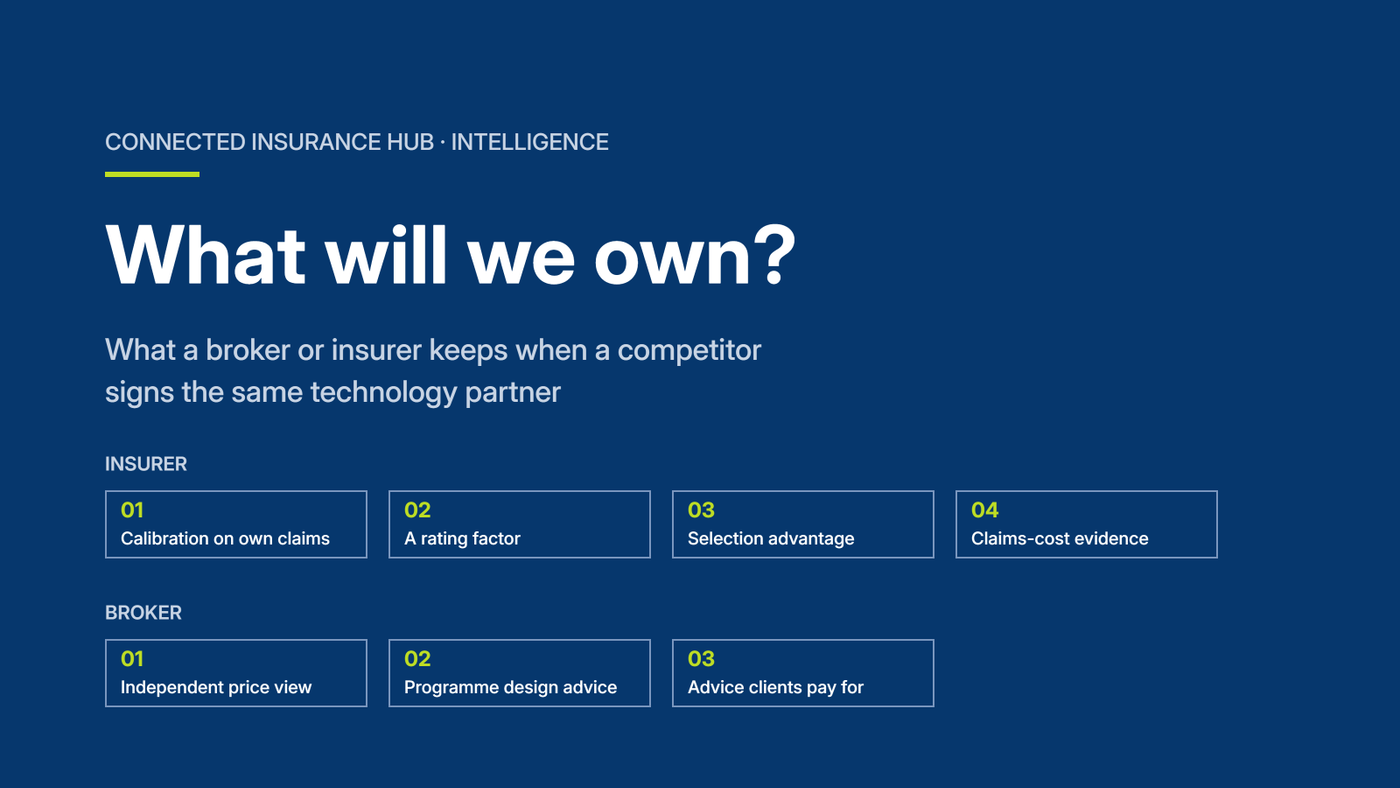
What an insurer can own
Calibration against its own claims. A technology company can sense a risk. Only the insurer can establish what a signal is worth in priced loss, because only the insurer holds the claims. CIH's earlier analysis, Pricing the Shape, Not the Score, sets out how that division should work: the vendor determines what a derived index is made of, and the insurer determines what each component is worth from its own experience. That weighting is the insurer's asset. It never needs to cross to the vendor, and it improves with every year of matched experience.
A rating factor. The final rung of the CIH proof ladder is a filed rating factor: a signal the insurer has evidenced well enough to price on. Reaching it depends on credible causal evidence assembled against the insurer's own book, which a competitor cannot borrow.
Selection advantage, with conditions. The strongest independent evidence on monitoring programmes comes from Jin and Vasserman's study of a voluntary programme run by a major US auto insurer, covering more than one million customers between 2012 and 2016. Safer drivers self-selected into monitoring, and participants made 30 per cent fewer claims during the monitoring period than in later periods. The monitoring data was not shared with other firms, and the authors observe that such data can increase an insurer's market power if kept proprietary.
The study concerns US private motor, where drivers choose individually whether to be monitored. Commercial fleet cover differs: the fleet operator decides on the technology, and drivers do not opt in one by one. Under the Exportability gate of the Five Gates, the finding shows that the mechanism exists; it does not establish its size in a commercial book. With that limit stated, two conditions follow for any insurer. The selection advantage depends on the data remaining with the insurer that collected it. And part of the behavioural effect was tied to the period of monitoring itself, which is what the Persistence gate tests before any credit is given.
Evidence of claims-cost effects. Where technology changes how a loss develops, through earlier notice or intervention, the effect appears in the insurer's own claims files. The quality of that evidence matters. CIH's review of escape-of-water studies, What Escape of Water Proves About Proof, found that each more rigorous study reported a smaller effect. An insurer that measures the effect on its own claims, to its own standard, holds evidence that a competitor relying on vendor figures does not.
What a broker can own
A broker does not carry the risk, so its defensible assets take a different form. Connected data gives a broker three.
An independent view of the price
In commercial lines, an insurer prices an account by blending the account's own loss history with the rate for its class, using credibility weighting. Actuarial practice gives a small account's own experience little weight and a very large account's experience much more; the UK actuarial profession's work on fleet rating applies the same theory to commercial motor. The insurer also sees claims across its portfolio, which the broker and client do not.
Connected data changes what the broker can know about an individual account. With a client's operational risk data, analysed alongside its claims, the broker can form its own view of the account's forward loss potential and test whether the credit offered for a risk improvement is fair.
A composite case. The following is constructed for illustration; the figures are hypothetical and describe no real client.
A distribution business runs 250 vehicles from four depots. It installs telematics and, after six months, adds driver coaching at two of the depots. Eighteen months in, its risk indicators have improved and its claims frequency over the latest twelve months is lower than in the three years before. At renewal the insurer offers a 10 per cent reduction, citing a short record on a single account.
The broker's analysis supports a projection consistent with 20 per cent, and it sets out the case in the terms an underwriter applies:
- Honest baseline. Claims and indicators are measured per vehicle and per mile, so a change in fleet size or mileage cannot explain the improvement.
- Persistence. The improvement holds month by month across the full period. It is not confined to the first quarter after installation.
- Attribution. The two coached depots improved more than the two that were not coached, which links the change to the intervention.
- Pooled evidence. Across the broker's other clients using the same technology, accounts showing a similar change in indicators went on to lower claims frequency in the following year.
The insurer may still hold to its figure. The broker can then take the same evidence to a second market. Either way, the discussion has moved from negotiation over a number to an assessment of evidence, and the Five Gates have served as the framework for it.
Two features make this asset durable. The broker can present the evidence to more than one market. And the pooled view across clients, which carries more statistical weight than any single account, belongs to the broker.
Advice on how much risk to transfer at all
Negotiating the credit takes the decision to insure as given. A broker with a credible view of expected loss can also advise on the structure of the programme: how much to transfer, and how much to retain through a higher excess, an aggregate deductible or a captive.
The economics rest on how premium is built. Premium pays for the insurer's expenses and margin as well as expected claims. In UK commercial motor, insurers reported an aggregate expense ratio of 31 per cent for 2025/26: around 31p of each pound of premium went on expenses. Where data shows that losses below a threshold are frequent, stable and controllable, funding that layer directly avoids paying the loading on it. Retention brings its own costs, including administration, capital and volatility, so the case has to be made on evidence for each client. CIH's analysis The Captive That Pays for Prevention sets out how that case works for a captive.
This advice sits naturally with the broker. In UK law, the broker is generally the client's agent. The insurer is a counterparty to the transfer decision being assessed.
Advice the client pays for directly
The credibility of retention advice depends partly on how the broker is paid. A fee agreed between broker and client is regarded as the least problematic form of broker remuneration for transparency and conflicts of interest.
Large buyers have long paid on this basis: in an Airmic survey of 124 buyers, overwhelmingly at FTSE 250 companies, conducted in the mid-2000s, 95 per cent paid fees rather than percentage commission. The wider market looks different. Drawing on FCA statistics, a 2020 report by Mactavish estimated that brokers received as much as 80 per cent of their remuneration from insurers. Mactavish is not a neutral observer: it advises insurance buyers and takes all of its own revenue in client fees. The report also notes that not every broker takes payments from insurers.
Where a broker is paid by fee, advice to retain more risk carries no remuneration conflict. Where income rises with premium, the broker should be able to show that the advice holds regardless, and a commercial customer can require disclosure of the commission received.
Airmic warned at the time of its survey that transparency gains were reaching mainly large buyers, with smaller companies at risk of a two-tier market. Large buyers employ risk managers who commission and pay for advice. Where a client has no such function, connected technology could supply part of what one provides: data on exposures, tracking of improvement, and evidence an underwriter can assess. If that lowers the cost of advising a smaller account, risk advice becomes something a broker can price and sell to clients who have not bought it before. A broker that builds a profitable way of serving risk management at that scale holds something a competitor cannot acquire by buying the same technology.
The contest for the calibration
Set side by side, the insurer and the broker are seeking the same asset: a reliable mapping from risk signal to expected loss. The insurer builds it from its own book. The broker builds it from its clients, across markets.
A technology company sits between them, and both will ask whose calibration its data is feeding. The division set out in Pricing the Shape, Not the Score resolves this. The vendor supplies derived indices and exposes the components each party asks for. Each party applies its own weighting from its own experience, and that weighting never crosses back to the vendor. An insurer and a broker can then each build a calibration of their own from the same technology without either gaining the other's.
What a technology company should put on the table
A partner pitch should contain a section that answers the question directly: what will you own?
- Bounded exclusivity. Exclusivity limited by segment, class or period, on a proposition built with the partner. The technology itself remains available to the market.
- Co-developed derived indices. Indices specified with the partner, with data rights that leave the partner's weighting and calibration with the partner.
- Data packaged for advice. For brokers, outputs that support pricing challenge and programme design as well as discounts.
- Clarity on payments to brokers. Any payment from a technology company to a broker is a third-party payment that the broker must assess under FCA rules on conflicts of interest and inducements, which prohibit inducements that conflict with the broker's duty to its client. A partnership built on a referral fee therefore carries obligations for the broker that a partnership built on shared evidence does not.
The test
A partnership becomes compelling when each side can say what it will hold after a competitor signs the same agreement. For the insurer, that is calibration on its own claims. For the broker, it is an independent view of the risk and advice the client values enough to pay for. The technology company's task is to make both possible: to supply the evidence each party needs to build something of its own, instead of selling access that any competitor can match.
Sources
- Jin, Y. and Vasserman, S., Buying Data from Consumers: The Impact of Monitoring Programs in U.S. Auto Insurance, NBER Working Paper 29096: https://www.nber.org/papers/w29096 ; NBER Digest, October 2021: https://www.nber.org/digest-202110/voluntary-self-monitoring-auto-insurance-market ; data not shared with other firms: https://www.ftc.gov/system/files/documents/public_events/1494697/jinvasserman_1.pdf
- Casualty Actuarial Society, Proceedings 1972, experience rating and credibility by size of risk: https://www.casact.org/pubs/proceed/proceed72/72156.pdf ; Longley-Cook, An Introduction to Credibility Theory, CAS 1962: https://www.casact.org/pubs/proceed/proceed62/62194.pdf
- Institute and Faculty of Actuaries, Fleet rating (application of credibility theory to fleet experience): https://www.actuaries.org.uk/system/files/documents/pdf/fleet-rating.pdf
- Insurance Times, Top 50 Insurers 2026 (Insurance DataLab SFCR analysis; commercial motor expense ratio 31%, 2025/26): https://www.insurancetimes.co.uk/analysis/top-50-insurers-2026-commercial-lines-retain-underwriting-edge-as-motor-returns-to-profit/1459685.article
- Insurance Institute of London, Identifying, avoiding and managing conflicts of interest: https://iilondon.co.uk/media/15891/identifying-avoiding-and-managing-conflicts-of-interest.pdf
- Pinsent Masons, Insurance broker remuneration: law and regulation: https://www.pinsentmasons.com/en-gb/out-law/guides/insurance-broker-remuneration-law-and-regulation
- FCA Handbook SYSC 10: https://www.handbook.fca.org.uk/handbook/SYSC/10.pdf ; ICOBS 2.3: https://www.handbook.fca.org.uk/handbook/ICOBS/2/3.html
- FCA, General insurance brokers: acting for commercial customers: https://www.fca.org.uk/firms/general-insurance-brokers-acting-commercial-customers
- Insurance Times, Airmic survey of FTSE 250 insurance buyers: https://www.insurancetimes.co.uk/airmic-survey-increased-broker-remuneration-transparency/1329367.article
- i-law, "Increased broker transparency": https://www.i-law.com/ilaw/doc/view.htm?id=52347
- Mactavish, Broker Conflicts, May 2020: https://www.mactavishgroup.com/wp-content/uploads/2020/05/Mactavish-Broker-Conflicts-Report.pdf ; Mactavish fee model: https://www.mactavishgroup.com/foodandbeverage