
In brief
The UK expects a dedicated captive insurance regime to go live in mid-2027. Until now, UK groups wanting a captive have had to set one up offshore.
A captive is the most natural buyer of prevention the UK market has had. It keeps the saving from avoided losses, it retains the frequency layer where risk technology's evidence is strongest, and it can act on credible causal evidence without waiting for a filed rating factor.
The constraint is evidence quality. A retained-loss claim has to satisfy a captive board, an actuary, a transfer pricing review and, for compulsory lines such as motor and employers' liability, a fronting insurer.
Groups and technology companies that design the comparison before deployment will be ready at launch. Those that wait will spend the first underwriting years building a baseline they could have started now.
Why this is a discussion for now
The UK is one of the world's largest insurance markets, yet it has no captive insurers of its own. The FCA states plainly that none are currently established in the UK, and that businesses wanting the structure set one up in another jurisdiction. Guernsey has been the main beneficiary. It held 196 captives and 126 cell captives at the end of 2025, and an estimated 40% of FTSE 100 companies held a captive there in 2024 (Milliman).
That is changing on a defined timetable. The Chancellor committed to a bespoke framework at Mansion House in July 2025. On 14 July 2026 the PRA and FCA published parallel consultations, CP11/26 and CP26/29, with draft rules. The consultations closed on 14 October 2026 and the regulators expect to implement the regime in mid-2027 (Skadden). The window between now and launch is when groups run feasibility studies, and feasibility studies are where the retained-risk case is written.
Demand is already visible. In Airmic's 2026 members' survey, 58% of respondents said they were considering a UK captive and 42% had increased their use of captives despite softer market conditions. Airmic estimates its members place more than £5.5 billion of annual premium through captives.
The market cycle sharpens the point rather than blunting it. Commercial property rates continued to soften into 2026, and AM Best expects captives' net retained exposures to decline this year (IFC Review). In a soft market, a captive cannot justify itself on price relief. It has to justify itself on knowing its own risk better than the market does, and on reducing that risk. That is a prevention argument, and prevention arguments need evidence.
What the UK captive regime is
The regime creates a third category of UK insurer, separate from Solvency UK firms and non-directive firms, with its own rulebook provisions and supervisory statement (A&O Shearman). The PRA's reasoning matters for anyone selling risk data. It treats single-parent captives as low risk partly because there is little information asymmetry between captive and parent, and captives often hold high-quality claims history.
| Feature | Proposed position |
|---|---|
| Scope | Single-parent (pure) captives only at launch; cell, group and association captives earmarked for later consultation |
| Basis | Direct insurance or reinsurance behind a fronting insurer |
| Who can be insured | The parent group, plus non-group undertakings with a material contractual and financial relationship to it |
| Property, casualty, general liability | Permitted |
| Compulsory lines, employee benefits, D&O naming individuals | Reinsurance only |
| Life, pensions, unrelated third-party risk, investment risk | Prohibited |
| Baseline capital | £100,000 of Tier 1 capital, against a £2.4 million minimum floor under Solvency UK |
| Captive capital requirement | The higher of 10% of net written premium and 10% of net insurance liabilities; letters of credit and parental guarantees can count as Tier 2 |
| Governance | One Senior Management Function (SMF1) as a minimum and at least one non-executive director |
| Authorisation and reporting | Target of four to six weeks for a complete application; simplified annual returns plus audited accounts |
Sources: A&O Shearman, PwC, Clyde & Co. Positions are proposals and may change in the final policy statements.
Two features deserve attention beyond the headline capital relief. First, the Consumer Duty would not apply to UK captives (Clyde & Co), which removes a layer of conduct process but leaves prudential and tax scrutiny intact. Second, the material non-group perimeter lets a group insure exposures that arise from its supply chain contracts. That opens retained cover for risks the group does not directly control, which is where the evidence question becomes hardest.
The regime also has limits that the market has noted. The restrictions on compulsory lines and employee benefits are tighter than in Bermuda, and the PRA has indicated it may revisit some exclusions as the regime matures.
Why a captive is the natural buyer of prevention
The central problem in risk technology has never been whether prevention works. It is who keeps the saving. Under conventional transfer, a risk owner who cuts claims through technology shares the benefit with an insurer, waits years for it to show in pricing, and may lose it entirely at the next market turn. The Prevention-to-Pricing Gap set out how long that wait can be.
A captive changes the arithmetic in three structural ways.
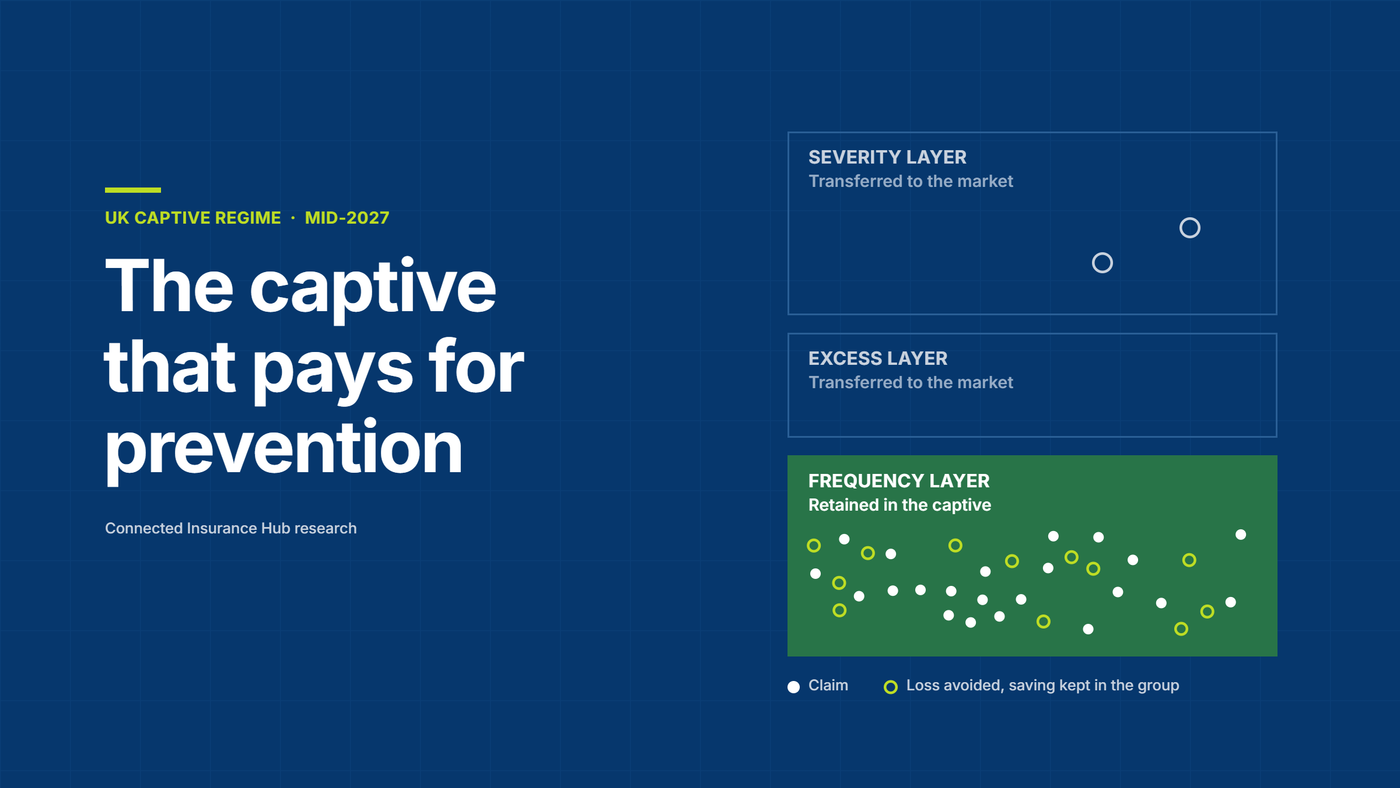
It keeps the retained saving. Every pound of avoided loss in the retained layer stays inside the group. There is no insurer margin on the saving and no dependence on a carrier's view of the cycle.
It retains the layer where the evidence is strongest. Captives typically hold the attritional, high-frequency layer and buy the severity layer from the market. Risk technology's best evidence also sits in frequency: collisions, slips, minor escape-of-water events. The retention structure and the evidence base line up, which is rare.
It shortens the proof ladder. On the Connected Insurance Hub proof ladder, a claim climbs from anecdote to correlation, then to credible causal evidence, and finally to a filed rating factor. A commercial insurer needs the top rung before price moves. A captive can adopt a credible causal estimate directly into its premium basis and reserving, provided its actuary and board accept it. The last and slowest rung drops away.
The regime adds a fourth, smaller effect. The captive capital requirement scales with net written premium and net insurance liabilities. Lower retained losses mean a lower actuarially sound premium and lower reserves, so prevention also releases capital. The effect is modest at a 10% ratio, but it is real and it compounds with the loss saving.
One constraint sits over all of this: premiums paid to a captive must be priced on arm's-length terms. The OECD Transfer Pricing Guidelines deal with captive insurance directly in Chapter X, and accept actuarial analysis as one way to set an arm's-length premium for a particular risk (OECD TPG Chapter X, para 10.219). HMRC applies transfer pricing to insurance contracts between an offshore captive and connected UK companies, and its manual tells inspectors to consider a transfer pricing review whenever they examine a captive (HMRC INTM210500).
The UK precedent is DSG Retail v HMRC [2009] UKFTT 31 (TC), where the tribunal found Dixons' arrangements with its Isle of Man captive were not at arm's length. One detail matters here: the tribunal traced the excess profit partly to the group's own past claims data, and returned it to the parent (TP Cases summary). Risk data can create value that tax authorities attribute to the operating business. Onshoring brings no tax concession either, because HM Treasury has ruled out a special tax regime for captives (Slaughter and May). A premium reduction justified by prevention therefore needs evidence that would satisfy a transfer pricing review as well as an actuary. That is a higher bar than a vendor dashboard, and it is the right one.
The fronting constraint
The lines where UK risk technology is most mature are largely compulsory. Fleet telematics sits against motor third-party liability. Workplace safety platforms, computer vision and wearables sit against employers' liability. Under the proposed regime, compulsory lines may be written by a UK captive only on a reinsurance basis, behind a conventional insurer subject to Solvency UK (Sidley).
This matters more than it first appears. The fronting insurer issues the policy, handles the claims relationship and carries counterparty exposure to the captive. It will set collateral, fees and its own view of the retained layer. A captive that believes its telematics programme has cut collision frequency still has to persuade the front, and the front applies its own evidence standard.
The practical consequence is that a captive-grade evidence file has two readers. The captive board and its actuary decide whether to retain more and price the retention lower. The fronting insurer and the captive's reinsurers decide whether to accept that view in collateral, attachment points and terms. Evidence written only for the first reader will stall at the second.
Property, general liability and other non-compulsory lines can be written direct. For flood intelligence, escape-of-water detection and similar property technology, the captive can act on its own evidence with fewer intermediaries. That makes non-compulsory property the cleanest early test of the thesis.
The captive evidence file, gate by gate
A captive is advantaged on two of the Five Gates and exposed on the other three. Attribution remains the master gate. The table sets out what a captive-grade file has to show at each one.
| Gate | The captive's question | What the file must show | Captive position |
|---|---|---|---|
| Attribution | Did the technology cause the change in retained losses? | A comparison design: staggered rollout across sites or fleets, matched control units, or a pre-registered before-and-after with stated confounders | Exposed. One group is a small sample, and rollouts are rarely staggered by design |
| Honest baseline | What would retained losses have been without it? | Five or more years of the group's own claims, adjusted for exposure growth, claims inflation and any change in deductibles or retention | Advantaged. The captive holds its own loss history at claim level |
| Persistence | Does the effect hold after year one? | Year-on-year effect by cohort, with usage and intervention rates tracked alongside claims | Advantaged. A captive is a multi-year vehicle that can observe decay directly |
| Exportability | Will the fronting insurer and reinsurers accept the estimate? | Method, data lineage and independence of the analysis documented to a standard an outside actuary can audit | Exposed. Internal conviction carries no weight with a front |
| Materiality | Is the saving large enough to change retention, price or capital? | Avoided retained loss expressed per unit of exposure and set against technology and intervention cost | Exposed. Attritional savings can be real but too small to move a programme |
The gate most likely to fail is Attribution, for a reason specific to captives. Groups tend to form or expand captives after a run of bad loss years. Losses that fall afterwards will partly regress towards the mean whatever technology is installed. A file that credits all of the improvement to the technology will overstate the effect, and an experienced front will discount it. The Counterfactual Contract sets out how to agree the comparison before deployment so that this argument is settled in advance.
What the evidence cannot establish
The argument in this piece is structural. It shows that a UK captive is well placed to fund and measure prevention. It does not show that captive owners will do so, and four limits should be stated plainly.
- No UK data exists yet. With no UK captives in operation, there is no domestic record of how captive owners treat loss control budgets. Evidence from offshore captives of UK groups is relevant but rarely published.
- Formation surveys measure intent. Airmic's 58% figure records consideration, which is a long way from authorisation.
- Soft markets mask effects. Falling commercial rates can make retained-layer savings look smaller in relative terms, or tempt groups to shrink retentions just as evidence matures.
- The supply chain perimeter is untested. Insuring material non-group undertakings means retaining risk the group cannot directly control. Prevention evidence from a supplier's sites is harder to obtain and harder to attribute.
Falsification conditions
The thesis should be treated as wrong if any of the following holds by the end of 2029, two years after the expected launch.
- UK authorisations come mainly from redomiciled offshore captives with unchanged retentions, so the regime moves the address of the risk without moving the risk itself.
- UK captive owners running risk technology show no reduction in retained loss frequency against an exposure-adjusted baseline across two or more underwriting years.
- Fronting insurers price the compulsory layers they front without reference to the captive's evidence, so that evidence changes neither collateral nor terms.
What it means for each audience
Risk owners and finance directors. Build the evidence file before the feasibility study is signed off. A captive business plan that assumes loss improvement without a comparison design will be discounted by the front and the actuary. The cheapest moment to stagger a technology rollout is before it starts. The Safety Data You Already Hold is the natural starting inventory.
Technology companies. A UK captive is a buyer whose own ledger records the vendor's effect. That rewards vendors who can show avoided retained loss per unit of exposure, and it exposes vendors who can only show engagement or alert volumes. The strongest commercial structure ties part of the fee to retained-loss outcomes measured against an agreed counterfactual. Vendor-produced case studies will not carry a captive board, and they will not carry a front.
Insurers and reinsurers. Fronting and reinsuring UK captives puts carriers next to the retained layer and its data. A carrier that can read and credit a captive's evidence file has a basis for differentiated collateral and attachment terms. One that cannot will compete on fronting fees alone.
Brokers and advisers. The advisory value moves upstream into designing the evidence and the retention together. Placing the severity layer above a captive is a transaction. Deciding how much frequency to retain, on what evidence, and how to prove the saving to a front is an advisory question.
Verdict
The UK captive regime will not create a market for risk technology on its own. What it does is give UK groups a vehicle that keeps the saving from prevention, retains the layer where the evidence is strongest, and can act on credible causal evidence without waiting for a filed rating factor. That makes the captive the most natural UK buyer of prevention the market has had.
The constraint is evidence quality. Retained-loss claims must survive a captive board, an actuary, a tax adviser and, for compulsory lines, a fronting insurer. Groups and technology companies that design the comparison before deployment will be ready when the regime opens in mid-2027. Those that wait for launch will spend the first underwriting years building a baseline they could have started now.
Sources and evidence tiering
No vendor-produced evidence is load-bearing in this analysis. Broker-published captive data was deliberately left out.
- Tier 1FCA, CP26/29: A tailored regime for captive insurance. No UK captives today; consultation dates.
- Tier 1HMRC International Manual, INTM210500. Transfer pricing of captive insurance contracts.
- Tier 1DSG Retail Ltd v HMRC [2009] UKFTT 31 (TC). UK case law on captive pricing.
- Tier 1OECD Transfer Pricing Guidelines, Chapter X, para 10.219. Actuarial pricing of captive premiums.
- Tier 2A&O Shearman, Captive insurance comes home. Scope, perimeter, capital, governance, PRA rationale.
- Tier 2Skadden, UK's PRA and FCA offer proposals. Timeline to mid-2027.
- Tier 2PwC, Regulators propose UK captive regime. Capital requirement, authorisation target.
- Tier 2Clyde & Co, PRA and FCA consult. Consumer Duty disapplied; PCCs deferred.
- Tier 2Sidley, A new tailored regulatory regime. Compulsory lines reinsurance only.
- Tier 2Milliman, CP11/26 analysis. Guernsey captive counts; FTSE 100 share.
- Tier 2Slaughter and May, UK captive regime proposals. No special tax regime.
- Tier 2Airmic, 2026 members' captive survey. Intent to consider a UK captive; captive premium.
- Tier 2IFC Review, Repositioning captive strategy. Soft market; AM Best view on retained exposures.
The tax treatment of a UK-resident captive under the new regime has not yet been set out in detail. Groups should confirm it with a tax adviser.